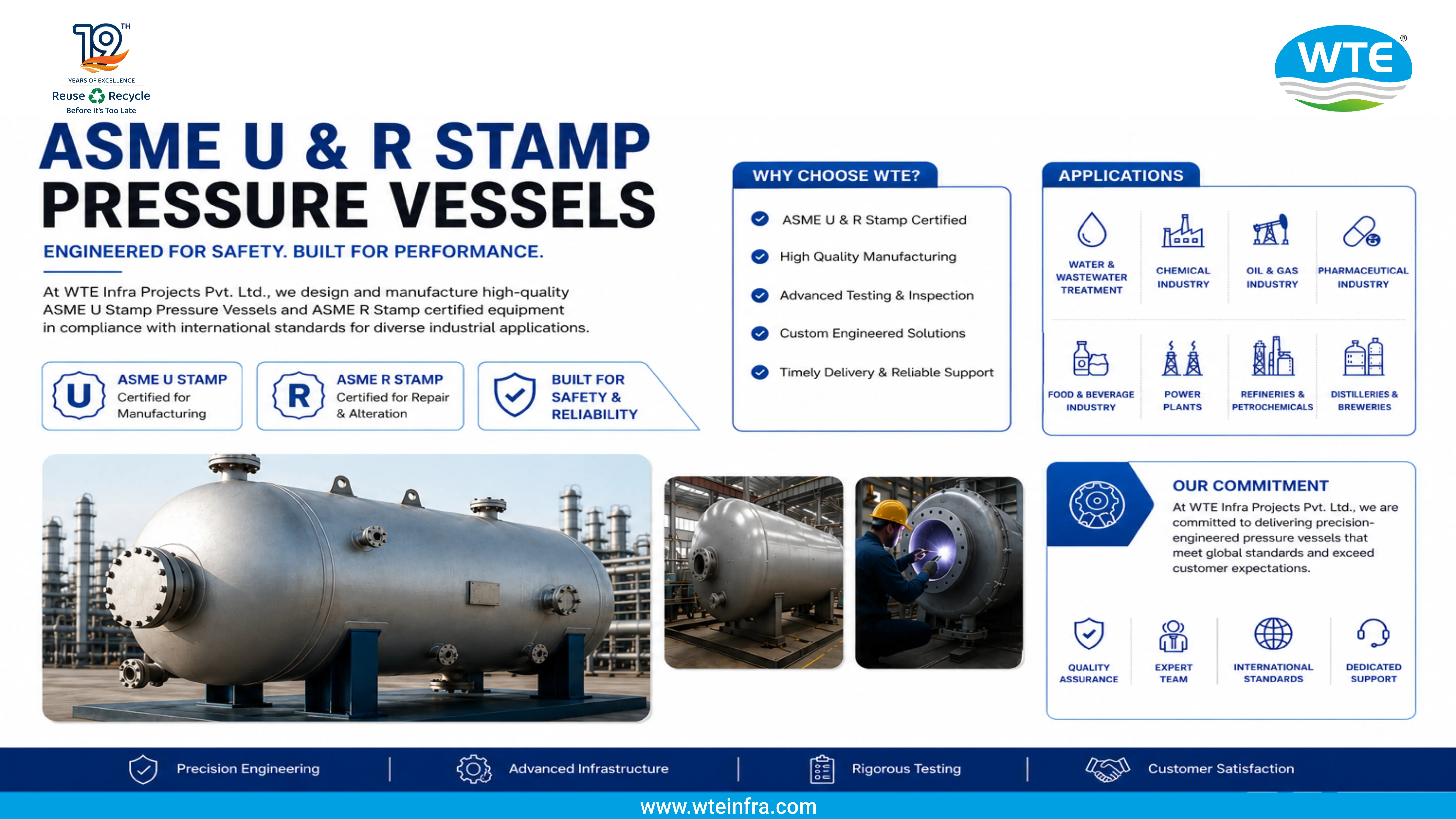
ASME U & R Stamp Pressure Vessels: Complete Guide to Certified Pressure Vessel Manufacturing
In industries where safety, reliability, and compliance are non-negotiable, ASME U Stamp Pressure Vessels and ASME R Stamp certified equipment play a critical role. From chemical plants and refineries to pharmaceutical industries, food processing units, and water treatment systems, pressure vessels are essential for handling high-pressure operations safely and efficiently.
At WTE Infra Projects Pvt. Ltd., we manufacture high-quality pressure vessels designed to meet stringent international standards while delivering long-term operational performance across industrial applications.
What is an ASME U Stamp Pressure Vessel?
An ASME U Stamp Pressure Vessel is a vessel manufactured according to the standards of the ASME Boiler and Pressure Vessel Code Section VIII Division 1.
The U Stamp certification confirms that the pressure vessel has been designed, fabricated, inspected, tested, and documented according to internationally accepted safety standards.
Industries Using ASME U Stamp Pressure Vessels
- Chemical processing plants
- Oil & gas industries
- Water treatment plants
- Pharmaceutical industries
- Food & beverage processing
- Power plants
- Distilleries & breweries
- Refineries and petrochemical industries
What is an ASME R Stamp?
The ASME R Stamp is issued by the National Board of Boiler and Pressure Vessel Inspectors. It authorizes certified companies to perform repair, alteration, and maintenance of pressure-retaining equipment.
Difference Between ASME U Stamp and ASME R Stamp
| Feature | ASME U Stamp | ASME R Stamp |
|---|---|---|
| Purpose | Manufacturing new pressure vessels | Repair and alteration of existing vessels |
| Governing Standard | ASME BPVC Section VIII Div 1 | National Board Inspection Code |
| Application | New vessel fabrication | Repair and maintenance work |
| Certification Authority | ASME | National Board |
Why ASME Certification Matters for Pressure Vessels
Choosing an ASME certified pressure vessel manufacturer is important because pressure vessels operate under high pressure and temperature conditions.
Key Benefits of ASME Certified Pressure Vessels
- Enhanced industrial safety
- International compliance
- Superior quality assurance
- Long-term reliability
- Reduced operational risk
- Improved durability and performance
Key Components of an ASME Pressure Vessel
- Shell
- Dish ends
- Nozzles
- Flanges
- Supports
- Manholes
- Safety valves
- Internal components
- Reinforcement pads
Types of ASME Pressure Vessels
Horizontal Pressure Vessels
Used for storage, process applications, air receivers, and chemical storage.
Vertical Pressure Vessels
Ideal for space-saving installations, filtration systems, and process applications.
Heat Exchanger Pressure Vessels
Used in industrial cooling, heating, and thermal transfer applications.
Air Receiver Tanks
Commonly used in compressor systems and pneumatic operations.
Reactor Vessels
Widely used in chemical processing and pharmaceutical industries.
Applications of ASME U Stamp Pressure Vessels
Water & Wastewater Treatment
- Pressure filtration systems
- Reverse osmosis systems
- Demineralization plants
- Ultrafiltration systems
Oil & Gas Industry
- Separator vessels
- Storage vessels
- Gas processing systems
Chemical Industry
- Chemical reactors
- Storage tanks
- Process vessels
Pharmaceutical Industry
- Sterile processing vessels
- Mixing tanks
- High-pressure process vessels
Manufacturing Process of ASME Pressure Vessels
1. Design & Engineering
The vessel is designed based on operating pressure, temperature, fluid properties, corrosion allowance, and applicable code requirements.
2. Material Selection
Common materials include carbon steel, stainless steel, duplex steel, and alloy steel.
3. Fabrication
Fabrication involves plate rolling, welding, nozzle fabrication, assembly, and dimensional inspection.
4. Welding Procedures
ASME-approved welding procedures help ensure structural strength, leak-proof joints, and safe performance.
5. Inspection & Testing
- Hydrostatic testing
- Radiography testing
- Ultrasonic testing
- Dye penetrant testing
- Visual inspection
6. Documentation
- Material test certificates
- Welding records
- Inspection reports
- Hydro test certificates
- ASME compliance documentation
Benefits of Choosing WTE Infra Projects Pvt. Ltd.
WTE Infra Projects Pvt. Ltd. offers engineered pressure vessel manufacturing solutions with a focus on quality, precision, safety, and long-term performance.
- ASME U & R Stamp certified pressure vessel solutions
- Experienced engineering and fabrication team
- Customized pressure vessel manufacturing
- Strict quality control and inspection process
- Advanced manufacturing infrastructure
- Industrial compliance support
- Reliable project execution
Important Factors to Consider Before Buying a Pressure Vessel
- ASME certification
- Design pressure and temperature
- Material compatibility
- Corrosion resistance
- Testing standards
- Documentation requirements
- Application-specific design
Frequently Asked Questions
What is ASME U Stamp certification?
ASME U Stamp certification confirms that a pressure vessel has been designed and manufactured according to ASME Boiler and Pressure Vessel Code Section VIII Division 1 standards.
What is the purpose of the ASME R Stamp?
The ASME R Stamp authorizes certified companies to repair and alter pressure vessels according to National Board standards.
Why are ASME pressure vessels important?
ASME pressure vessels ensure industrial safety, international compliance, reliable operation, and reduced operational risks.
Which industries use ASME pressure vessels?
ASME vessels are used in water treatment, chemical processing, oil & gas, pharmaceuticals, food processing, and power generation.
What materials are used in ASME pressure vessels?
Common materials include carbon steel, stainless steel, duplex steel, and alloy steel.
How are ASME pressure vessels tested?
Testing methods include hydro testing, radiography testing, ultrasonic testing, dye penetrant testing, and visual inspection.
What is the difference between pressure vessels and storage tanks?
Pressure vessels are designed to operate under pressure, while storage tanks generally store liquids or gases at atmospheric pressure.
How long does an ASME pressure vessel last?
With proper maintenance and operation, ASME pressure vessels can last for decades depending on the application and operating conditions.
Conclusion
ASME U & R Stamp Pressure Vessels are essential for industries requiring safe, reliable, and internationally compliant pressure-handling equipment. Whether for manufacturing, processing, storage, or repair applications, ASME-certified vessels provide strong quality assurance and operational safety.
WTE Infra Projects Pvt. Ltd. delivers engineered pressure vessel solutions designed for industrial excellence, durability, and compliance with global quality standards.
If you are looking for high-quality ASME certified pressure vessels for your industrial applications, connect with WTE for customized pressure vessel manufacturing solutions.